
What If the UAE Disappeared From Earth? The Global Impact of Losing the World’s Strategic Hub
It’s an unusual — and almost impossible — question: What would happen if the United Arab Emirates ...
Bilal Bahadar
11/11/20256 min read
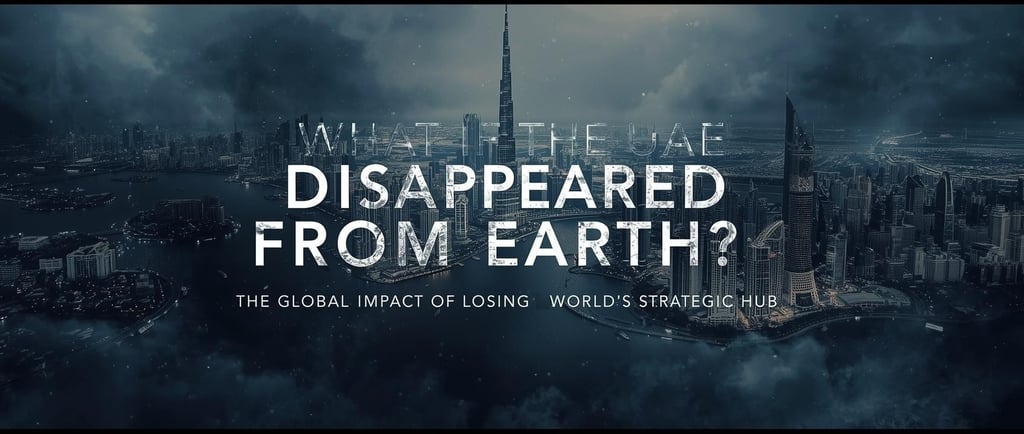
It’s an unusual — and almost impossible — question: What would happen if the United Arab Emirates suddenly disappeared from the face of the earth?
At first, it might sound like an imaginative “what if” scenario. But when you begin to look at the hard numbers, trade figures, aviation data, and the interconnected global systems that rely on this small yet mighty nation, the answer becomes startling. The disappearance of the UAE; and particularly Dubai; would cause a ripple effect across nearly every major global sector: trade, logistics, energy, travel, tourism, finance, real estate, and even humanitarian aid.
Let’s explore what the world would look like if the UAE; one of the most strategically located, connected, and influential nations; suddenly ceased to exist.
1. The Collapse of Global Air Travel
Dubai International Airport (DXB) is not just another airport; it’s a global hub, a nerve center that connects East to West.
In 2024, DXB handled an astonishing 192 million travelers, a record-breaking number that reflects its dominance as the world’s busiest international airport. The airport’s designed capacity of 200 million passengers per year positions it as a critical transit point for flights connecting Asia, Europe, and Africa.
If the UAE disappeared, hundreds of thousands of flights would instantly lose their most important layover and refueling point. Emirates Airline alone operates over 3,600 flights weekly, linking 150+ destinations. The sudden closure of UAE’s airspace would not only ground fleets but force global airlines to reroute, costing the aviation industry an estimated $100 billion in additional operational expenses due to longer routes, fuel consumption, and congestion elsewhere.
In practical terms, a flight from London to Sydney would no longer make a stop in Dubai — instead, airlines would struggle to find alternative hubs with the same connectivity, efficiency, and passenger infrastructure.
In a world without the UAE, the global travel network would collapse; literally overnight.
2. The World’s Trade Routes in Chaos
The UAE’s location between Asia, Africa, and Europe makes it one of the most strategically vital points on the global trade map. Dubai’s Jebel Ali Port — the largest man-made harbor in the world; handles over 28 million tons of cargo annually and serves as a key re-export hub for goods destined for over 140 countries.
If the UAE were gone, 28 million tons of goods would be stranded at sea or redirected through less efficient routes, increasing shipping costs by billions. The global supply chain; already fragile in a post-pandemic world; would experience catastrophic delays, shortages, and cost spikes.
Electronics, automotive parts, medical equipment, construction materials, and even consumer goods like clothing and home appliances rely heavily on Dubai’s free zones and logistics infrastructure.
To put it simply, if Dubai disappeared, the world’s trade arteries would clog.
3. Energy Shock: 4% of Global Oil Supply Gone
The UAE is among the top 10 oil-producing nations in the world, contributing roughly 4% of the global oil supply. This might not sound overwhelming at first, but removing 4% from a system as sensitive as the global oil market would cause chaos.
Oil prices could skyrocket overnight, potentially surpassing $200 per barrel, as nations scramble to stabilize supply and reroute production. Major economies dependent on Gulf energy; from India and China to Japan and parts of Europe; would be severely hit.
Moreover, the UAE is not just an oil exporter; it’s a global energy innovator investing heavily in renewables, hydrogen, and sustainable projects like Masdar City. The loss of the UAE would set back international sustainability efforts and regional energy cooperation by decades.
4. The Financial and Gold Market Shock
Dubai is the second-largest gold transporter in the world. The Dubai Multi Commodities Centre (DMCC) has become a global hub for trade in gold, diamonds, and other precious metals, with billions of dollars in transactions passing through its ecosystem each year.
If the UAE vanished, global commodities markets would face extreme volatility. The interruption in gold flows through Dubai could disrupt everything from jewelry exports in India to investment-grade bullion reserves in Europe.
In addition, Dubai’s financial institutions and free zones host thousands of international companies using the UAE as a regional base for operations in Africa, Asia, and the Middle East. Over 25,000 international businesses are registered across zones like DIFC, DMCC, and JAFZA. Their sudden disappearance would destabilize global finance, cross-border trade, and investment ecosystems.
5. Tourism Industry Collapse
In 2024 alone, 87 million people visited Dubai, making it one of the most visited cities on the planet; even surpassing destinations like Paris and New York. Tourists come for world-class attractions such as the Burj Khalifa, Palm Jumeirah, Dubai Mall, Museum of the Future, and luxury resorts in Abu Dhabi, Sharjah, and Ras Al Khaimah.
The disappearance of the UAE would cause an estimated $250 billion annual loss to global tourism. Airlines, hotels, and hospitality chains across Asia and Europe rely on Dubai’s tourism-driven economy. Moreover, countless travel-dependent businesses; from local guides and luxury brands to cruise liners; would suffer long-term effects.
The UAE is more than a destination; it’s a bridge between cultures, offering safe, modern, and luxurious experiences that attract millions. Its loss would leave a cultural and economic void that no other city could fill.
6. Humanitarian and Food Supply Crisis
Beyond its skyline and luxury, the UAE plays a crucial role in global humanitarian logistics. The International Humanitarian City (IHC) in Dubai is the world’s largest logistics hub for humanitarian aid, supporting over 130 UN and NGO organizations.
Every year, approximately $14 billion worth of food and medical aid flows through UAE ports and airports to Africa and the Middle East.
If the UAE disappeared, millions of people in Africa and conflict zones across the Middle East would lose access to critical food, vaccines, and relief supplies. The ripple effect could trigger widespread famine, increased migration, and social unrest.
7. 120 Nationalities — A Global Human Mosaic Lost
One of the UAE’s greatest strengths is its diversity. Home to more than 120 nationalities, it represents one of the most inclusive, multicultural societies in the world.
Expats make up roughly 89% of the UAE’s population. Among them, 28% are Pakistani and 38% are Indian, meaning 66% of the UAE’s people come from just these two nations; contributing their skills, culture, and ambition to the country’s economy and lifestyle.
If the UAE were gone, over 8 million residents would be displaced; losing their homes, jobs, and stability. But more than that, the world would lose a model of peaceful coexistence, where people of all religions and backgrounds work together harmoniously.
8. Real Estate & Global Investment Chain Broken
As a professional in real estate, it’s important to understand; and explain; that the UAE is not just a property market, but a global investment network.
Dubai’s real estate attracts investors from more than 170 countries, offering security, transparency, and high returns. The city is a benchmark for property innovation; from smart homes in JVC to luxury waterfront villas in Palm Jumeirah.
If the UAE disappeared, over $500 billion worth of property assets would be wiped off the global map. Thousands of real estate investors, developers, and agents would lose one of the safest and most profitable markets in the world.
Projects worth trillions in cumulative value; such as Dubai Creek Harbour, Expo City, Dubai South, and Meydan; would vanish, leaving the global property market with a massive vacuum that no city could instantly fill.
For investors who question “what if UAE collapses?”, the answer is clear: it won’t. The UAE’s real estate market is backed not just by infrastructure, but by global trust, forward-looking governance, and a population that believes in progress.
9. Economic Partnerships and Strategic Position
The UAE stands at the crossroads of three continents. Its strategic geographic location makes it an irreplaceable connector of trade routes between Asia, Europe, and Africa.
More than 65% of the world’s population can reach Dubai within an 8-hour flight, which is why global corporations base their regional headquarters here. From logistics giants like DP World to tech startups and luxury brands, every sector benefits from the UAE’s unmatched positioning and pro-business environment.
The loss of the UAE would cripple regional economies dependent on its ports, refineries, and business ecosystems. Saudi Arabia, Oman, Bahrain, and even parts of Africa rely heavily on UAE’s re-export infrastructure.
10. The Ripple Effect on Global Economy
Every segment; aviation, shipping, tourism, real estate, finance, logistics, energy, and humanitarian aid; is connected through the UAE. Removing it from the global equation could result in a trillion-dollar shock to the world economy.
Global inflation would rise as oil prices surge. Trade would slow as ports reroute. Airfares would increase. Supply chains would become unstable. And millions would lose their livelihoods.
This is how deeply the UAE is integrated into the world; not as an isolated Gulf nation, but as a global hub that fuels modern civilization.
Why the UAE Will Never Disappear — It Will Only Grow
Now, let’s come back to reality.
The idea of the UAE disappearing is impossible. The country is built on a vision that transcends geography and time. From humble beginnings just decades ago, the UAE has transformed itself into a symbol of innovation, resilience, and prosperity.
Under the leadership of forward-thinking rulers and with the collective effort of millions of residents, the UAE continues to set global benchmarks in technology, architecture, sustainability, and trade.
Instead of collapsing, the UAE is expanding; with mega-projects like Dubai Urban Master Plan 2040, Abu Dhabi Economic Vision 2030, and the UAE Centennial 2071.
In fact, the next phase of UAE’s growth is focused on space exploration, artificial intelligence, green energy, and digital economies; areas where the country is already leading globally.
Conclusion: A Nation That Defines the Future
If the UAE ever disappeared, the world would lose its most strategic connection point, one of its fastest-growing economies, and a living example of harmony and innovation.
But that’s not going to happen. The UAE isn’t a country built to vani; it’s a nation built to evolve.
For investors, travelers, and dreamers alike, the message is clear:
The UAE will not disappear. It will define the future.